Well, today I received my usual call from my mate, John Larsen, the Kiwi Marist priest in Ranong. He was on about a negative experience he had over the last couple of days with the Thai Church. My line was - That is why they need us here so that they can see another way of being Church.
Then in less than an hour after this call, I had three short experiences which were like responses to John's own dilemma.
Firstly, I spoke with Patrick, my Irish co-worker, about the Thai priests John found so unwelcoming. Patrick said that he experienced one of these same priests as being very shy while being also very kind. It struck me how true. Many Thais don't like to speak English in public as they don't want to make mistakes and appear as being stupid. That is just the way they are. I speak Thai and get laughed at. That is part of learning a language. For Thais, such a way is not the way to go as they don't want to appear silly before others. Yet how else can you learn a language?
Then my friend, Br Anurak, rang me. During the conversation, he mentioned that his Brothers were building a new campus for their Assumption College. The cost he quoted was just staggering. This is a poor Church that needs outside help to do its work!!??? Well this is part of its reality - big business using big money.
Lastly, I went to make a cup of coffee in the office. There were already three at the kitchen doing the same thing, along with the housekeeper. So it was crowded. This meant I got my cup and moved out of the way to the side bench. While putting the coffee powder into my cup, I spilt some on the bench. I go then to put hot water into my cup. While at the hot water pot, the housekeeper is already at the bench cleaning up my mess, telling all the others there in Thai about the mess I made. While I understood what she was saying, she acted as if I wasn't there or didn't understand her. Well, I spoke in Thai saying that I knew there was a mess and I would clean it up but she acted too quickly. My reflection on this simple happening was a "How dare she!!". She ignored me and spoke about me to the others, berating my mess. I find that sort of behaviour to be both arrogant and ignorant. I also reflected that, if I was a Thai priest, she would never have dared to act the way she did.
These are three simple events. They happened one after the other within such a short time. For me, they gave a powerful lived response to John Larsen and his own voiced concerns.
Firstly, all is not what it seems. Thais are shy and don't want to be placed in embarrassing situations - there again, who does? - involved in speaking another language. So they won't speak English with us and then appear reticent and maybe even unfriendly when this is not what is really at play.
Secondly, there is money in this Church. It is not a poor Church while sections of it are. I guess the issue is the inequitable distribution of wealth in the Thai Church, just like in society. Our role here in this Church is not to address financial poverty but ecclesological poverty due to the Thai Church being a young and inexperienced Church, restricted by its own limited history as Church.
Thirdly, there is an arrogance present here that is played against us.
It is all part of the big mix that makes up life in a Thailand. The mix is much bigger than what I experience in any one day - it is made up of the good,the bad and the ugly. That is life. That is the reality anywhere and it all makes up the mix that makes for an exciting life in Bangkok, a life which stretches your imagination; a life where you never stop learning.
What is the underlying lesson of all this is that we are not ruled in our life by our immediate life experiences. Life experience does speak to us and does affect us but it cannot simply rule us. We need to keep our focus, keeping our eye on the bigger picture. Why is it that we are anywhere - because of those good or bad experiences we have in life or because of our commitment to the bigger picture, to life, to the Gospel, because we keep our eye on what really matters to us?

I am John Murray, an Australian, Catholic priest of the Order of St Augustine. I live and work in Thailand and have been here since October 2005. I have many stories from my life journey and would simply like to share some of them. So hope you enjoy and go away sometime with a smile or a helpful little insight.
We gather
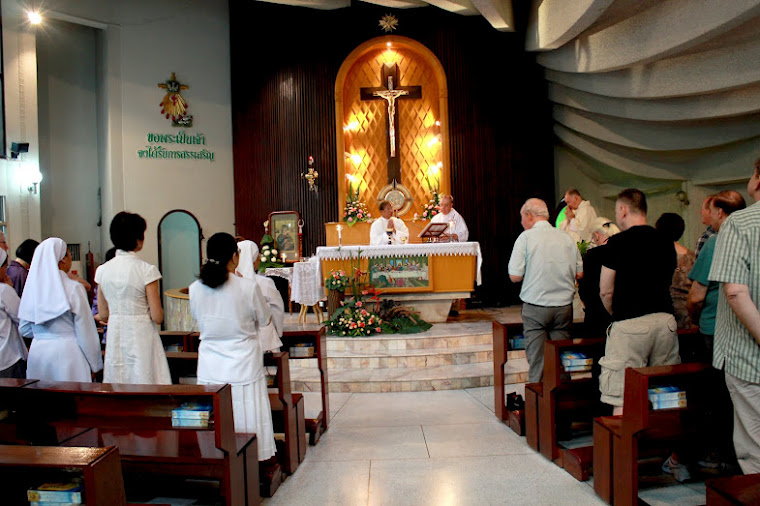
to give thanks for my 25 years.
Tuesday, March 29, 2011

Tuesday, March 22, 2011
A Prison Visit
On Monday, I was one of a number who accompanied the Apostolic Nuncio, Archbishop Giovanni d'Aniello, on his visit to Tham Hin refugee camp in Ratchaburi Province. It is one of nine refugee camps in Thailand and is home to over 9,500 mostly Burmese Karen refugees.
Today was the regular visit of our pastoral group to the prison for mass and a chat. All the prisoners we visit are foreign nationals who are there for drug trafficking. Like the Burmese refugees, they stay put for a long time in a restricted area and lifestyle but both groups are where they are for different reasons.
This is my week and I see a connection between what may be seen as two totally different events. The connection is the theme for each visit - solidarity.
Solidarity is a central human motif. It helps make us who we are as human beings. To live in solidarity gives expression to our shared human reality. It does not just make our load lighter. More than that it makes us more human and builds up our sense of dignity and integrity. it shows that we appreciate how much we have to share and learn from each other.
To deny solidarity serves to dehumanise us. It turns us into selfish, greedy individuals and stops us from achieving our greatness in life.
Our greatness is not just in who we are as individuals but in who we are together. In the words of the Nuncio at the camp - "We are for the other to show how our God is able to love."
Monday, March 21, 2011
March 23
Who is St Turibio?
He died in 1606, after having been the Archbishop of Lima in Peru from 1581. He was a Spaniard and a lawyer who was sent to Lima to be its Archbishop. It was a post that needed a strong and faithfilled character. Turibio was identified as such a person for the job.
So he went to Peru and faced the challenges of renewing a harsh colonial society and a corrupt clergy. As he undertook the reform of his clergy, he faced an argument that simply stated that this is the way it is here. To this, his reply was:
"Christ said, 'I am the truth'; he did not say, 'I am the custom.'"
How apt for here and today, when I hear so often the line like that of a Khun B, from my last entry, who so easily explains away an issue by saying -
"That is their culture and we have to accept that."
Tuesday, March 15, 2011
Arrogance
Today, I was on bus 504 to Sutthisarn where I go for the Bangkok Refugee Centre. Buses here have bus conductors who take the fares. So I tell the conductor "Sutthisarn". She did not say one word but signalled that she did not understand. So I said "Sutthisarn" again and she just gave me such an arrogant look. That is another side of the gentle, loving Thai. There is an arrogant side to them that can be seen sometimes. Today I experienced from this conductor one of the most arrogant looks I have ever experienced.
What is it about Thais that makes arrogance part of their mix? One theory is that it is their pride that their country was never colonised. Maybe that is the reason. Still they did pay a price for not being colonised and that is also part of their history but generally unrecognised by Thais. That enters into another part of Thai reality - their ignorance regarding their history or how their history is coloured in its presentation to them.
Maybe there is another way to approach this. Maybe it is not arrogance but part of the meeting between such different cultures that leads to a misunderstanding or a failure to really meet.
Having said this, I hold that the culture card is played too often and too strongly here. Everything and anything can be explained away here by simply saying - 'that is Thai culture' or 'we are Thai people'.
The most recent example of this just flabbergasted me. A is an American I know here who was married to a Thai woman for 15 years. They have a son. Two years ago, she just left them. It was a shock as it just happened without any explanation. A came into my radar again recently as he is quite sick.
I was talking with B, another American friend, about A's situation. B told me that I had to understand why A's wife would have left him and their son. She would have found another western male who could provide even more prosperously for her family in Isan. This is her duty within her family. As B said, that is their culture and we have to accept that.
Yes, B, that is their culture but just because it is their or anyone's culture it does not make it right or good. In this case, it is not a good part of their culture. You don't just fulfill your duty to find ways of financial support for your family at any cost and the expense of anyone or everyone who matter in your life. Any culture has good and bad aspects. Any culture deserves to be more informed and to be open for change for the better. It may not be easy to face a challenge to who we are but we don't just explain bad things away by saying that it is their culture. What is called for is a challenge to the culture where it is weak or acts against the good of others and against good, human values. Here is where other cultures can act to enrich the local culture. Here is a case where we just do not accept but see that we as Christians in the midst of Thai culture have something to add and we act to do that in the right and appropriate way. A great challenge in faith.
How did I get onto this? Through a simple arrogant look from a bus conductor at the beginning of my day in Bangkok.
Friday, March 11, 2011
It's about time
I seem to approach this blog with spurts. I work on it and then leave it for awhile and then I get back to it. Each time I get back to it, it seems to be because I am inspired to do so at the request of some named reader of my blog. I usually get back to it because of my niece, Carmel. This time it is because my firend, Simon, asked me yesterday and once again I feel inspired. So here goes.
Why have I not been regular on this blog? Lack of discipline? Too busy? I suspect the key is in how I describe my life as it has become since the end of last year. My life has become intense. I hate the word 'busy' as everyone says they are busy and I believe that then becomes the reason for doing so much in life that is important. I am too busy and that is why I forgot or that is why I did not ring you or that is why I can't help you ... so the list goes on. Being busy becomes like the excuse as we are all busy.
What do I mean by intense? At Caritas Thailand, I work on issues and processes that I find taxing. Being me, I am one to question life and its deeper issues. In helping urban refugees, I find work that is fulfilling but also tiring as the needs just seem so real and so never ending. So life is intense and I do get tired at the end of the day.
Then there is the whole challenge of life in a big, Asian city in the tropics. There are the contiual challenges of facing such a different culture and such a different language. It keeps you alive but challenging nonetheless.
Recently, some of the younger Thais at work asked me why I don't smile so much. I said that it is not my way. I do smile but not all the time. I explained where I come from and how a smile can be perceived. Here it is important to smile all the time. I was at the hospital yesterday and the Thai nurse who looked after me told me how she has to smile all day.
On being asked the question, I happily responded as best I could. I explained how a smile is read in so many diferent ways in my culture and that it is not always seen as appropriate or good, as it is here. If I smile back home while being serious, the other will question how serious I am. When a boy, my mother could tell if I was lying by if I was smiling. When at school, while getting in trouble, if I was smiling, the teacher would exclaim - Wipe that smile off your face, son! So a simple smile for me is not the way to go all the time as it can speak of other things in life and it can come to be quite shallow with so little meaning. Such is my way.
This speaks of another basic difference in our ways. This led to ones at work telling me that they did not always understand me because I do not always smile and sometimes I seem angry. I hoped that my explanation helped understanding.
The other interesting part of ths expose is that Thais read my being serious as being angry. I tell them this is not so. They see being serious as being angry and seem to witdraw in face of perceiving such a form of expression.
All this leads me to wonder about the basic questions of life yet again. It is fitting to do so as tomorrow is the First Sunday of Lent and the Gospel from Matthew presents Jesus' temptations in the desert. My take is that this gospel is facing us with the big question - What does it mean to be human?
This is the first big question for Lent. Lent has its roots in the early Church's using it as a time of communal preparation for baptising new members into the community of faith. These new members were adults, making an adult decision. As a period of preparation for these catechumens (as they were called), Lent was like an intensive course in the faith, leading to these adults making their purposeful decision for baptism and to the community's purposeful celebration of baptism. This was a serious time.
So the Gospels for the Sundays of Lent present the basic teachings of the Church for this course. Our lenten course begins this Sunday with lesson 1 - What does it mean to be human?
As I approach this question, I see that we are placed within the midst of a great force that pulls at us. We know our reality where we know our suffering, our weaknesses and our vulnerability. Yes, we have the success stories but we are continually reminded of the other side of who we are. Then the Church is so good at presenting the ideal which can serve to make us feel guilty or bad because we should be ... OR we should have ... I am sure I don't have to give the list. My suspicion is that our view of our humanity can be quite negative as that is the reality we so often experience - fighting, wars, disaster, fear, failure. Martin Luther named this pull in life as the paradigm of life. There are two sides to life for all of us. I guess we don't want to be overcome by the negative while being able to view the positive in a healthy way so that we are able to continually face the challenges of life, believing in who we are and becoming the people we are called to be.
A good friend of mine - a priest in Sydney -would simply say:
"When you face trouble, just sit with the chaos and see where it leads you. It will take you to where you need to be."
I don't want to go overboard. So this is enough for now. Otherwise I will lose my readers instead of gain them. From here, I must be more consistent. In a simple way, I am vocing my own paradigm in life. I want to and do but so often don't. Is that being human or using our humanity as an excuse for not doing?
Sunday, January 2, 2011
2011
Yes, it is the Year of the Rabbit. I know very little about rabbits. There is Bugs Bunny who is presented as fast moving, quick thinking and always on top of things. Then, as an Australian, I think of our experience of rabbits which were introduced from England. In the UK, they may be cute but, in Australia, they are unwanted pests as they eat all the vegetation. I guess that points to the two sides of any reality - the good and the bad, the dark and the light.
I know that in my own life. It is not only others who are bizarre and dysfunctional but also myself. There again, like others, I have my good side. No one is perfect; life is not perfect.
It makes me think of a line I heard on listening recently to a woman talk about the experience of having been trapped within an abusive relationship with a 'so called' boyfriend. She kept asking the same question - How could I? I think that is a question we all could ask about ourselves as we reflect on our total life experience. I think that is a basic shared question for humanity as we look at our world - How could we?
It made me think that the challenge is to transform this basic question of life into a statement on life - Look how far we have come! That is the challenge as we look back at life - not to bemoan how could we but to celebrate in how far we have come.
I often take a critical look at Thailand and Thais, and sometimes I wonder. Then yesterday, I had an experience of venting huge verbal anger on seeing myself as once again being at the receiving end of an arrogant and angry comment. Very seldom do I get angry. Yesterday was one of those few times. It was frightening for me as I just felt trapped by anger. The experience put me in touch once again with my own share of dysfunctional and bizarre behaiour. See, I thought, it is not just others, it is me too.
Maybe I needed this experience to push me that extra needed step as I then moved on from there to the milieu of a Thai family picnic. I saw the whole Thai scene so differently - not as separate or different or exclusive. Rather I experienced their acceptance and understanding of me. They had just happily let me be in my anger. They had handled me so well. I saw how it was just so enjoyable to be with them and enjoy them. I saw firsthand how Thais are just so much at home with their family. It is here they seem to thrive. How wondeful! I hope this stays.
The point is that, through experiencing my own dark side, I was put more in touch with others around me. We have so much more that binds us together than what divides us. Living here, one may often focus on the cultural divdes but the more important reality is our shared reality. Beyond being Thai or Burmese or Cambodian or Lao or farang, we are all human and that is what matters.
Happy Year of the Rabbit!
Wednesday, December 22, 2010
Christmas
I thought about it hard last night and decided it was time to get rid of some of those highlighted photos on my blog showing the phsyical results of political strife in Thailand. It is time to move one. Still I did leave one photo as a symbol that the troubles, the unrest, the issues are not yet resolved. 2011 will see ongoing political and social turmoil in a society that is experiencing rapid change and its effects for better or worse in a globalised world.
For now, it is Christmas and it is time to highlight the season. Even at Christmas, the paradoxes of our life continue, or maybe they are just highlighted even more due to the nature of the season. I mean - Bangkok may have a singing tree but Abu Dhabi has a $US11million, diamond tree. How gross!
Well, my two photos of Christmas highlight the paradoxes of my life. One shows the bright lights of Bangkok at Christmas. The other features our Vietnamese Santa at the Bangkok Refugee Centre striving to share a bit of joy with the children of urban refugee families in Bangkok. Life for them is hard. It is even harder at the moment as many of them are the victims of a current police crackdown on the urban refugee population within the city. One wonders why. Not all the reasons are due to the wish to uphold law and its due process. It is Christmas. Only if we could let everyone know what the season is really about, and not just through bright lights and those flippant, good humoured songs we all know for this time of the year.
Happy Christmas!!!!
Subscribe to:
Posts (Atom)