Living in Bangkok, I have found that the basic moral question to be asked is not what is good or bad? what is right or wrong? BUT What is real or unreal?
I was confirmed in this last night when I received a text message from a Thai friend whom I judged to be reasonably well off as he has a house and a car. He was asking for money to pay the monthly rent. I then automatically started questioning what our friendship was about. Living here, I knew immediately that was not the way to base any question on the situation.
It reminded me yet again that the basic question in living here is what is real or unreal? Don't make moral judgements on actions but pursue this basic question and see where it leads.
The reality is that, within a seemingly wealthy Thailand, life is tough for its poor, for its average citizens. The reality is that asking each other for money to help out is the way they live. Western standards do not apply and cannot be assumed. Human standards, however, do apply and we need to uphold what is good and natural in living together for the sake of mutual dignity and respect.
I sound like a priest.

I am John Murray, an Australian, Catholic priest of the Order of St Augustine. I live and work in Thailand and have been here since October 2005. I have many stories from my life journey and would simply like to share some of them. So hope you enjoy and go away sometime with a smile or a helpful little insight.
We gather
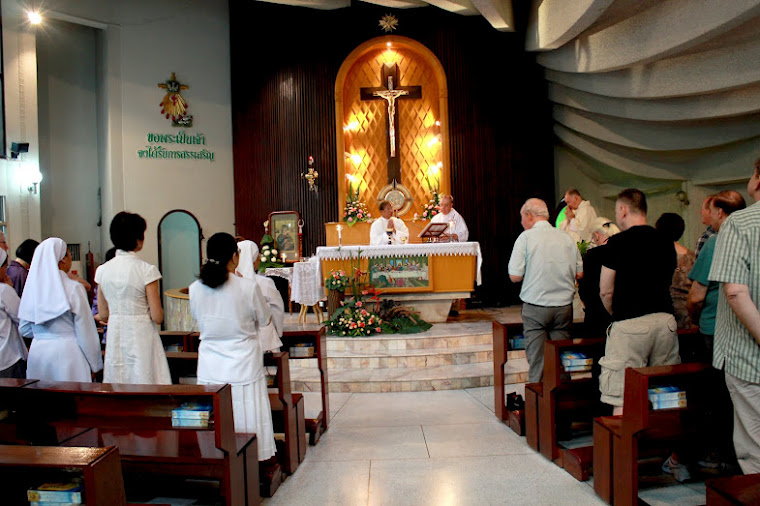
to give thanks for my 25 years.
Friday, April 29, 2011

Tuesday, April 26, 2011
Easter in Thailand ....
In a non-Christian country, Easter is just another day of the year. It just means nothing. Why shouldn't it? So it is that, as a Christian here, it seems like you have a special duty to celebrate Easter so as to show the flag, as they say.
So I was off to Good Friday services with a bunch from a Foundation for the poor in Bangkok run by the famous Fr Joe Maier, an American Redemptorist here longtime. In their van, I met their new volunteer - a young Australian male. He is here for six months to help look after the children. He is full of zeal and is just here to do some good in the world. He expresses that he has no experience of Church while he works in a Catholic school back home. I hear a conversation where he is asked to describe religion in Australia. He simply said that Australia is an atheistic country. I was shocked to hear such a blanket description. I would describe it as post-Chritian or secular but not atheistic. After all, there are many peoples that make up Australia and there are those that are part of Church - aren't there?
Still, I kept silent and I realised that, according to his own life experience, Australia is atheistic as he then said that all his friends were agnostics or atheists. So that is Australia for him. We both come from the same country but have such different experiences of it. For each of us, our experiences are valid and are just what they are. They are then reflected in how we describe our country. I can't deny his experience or his description.
Maybe celebrating Easter in a non-Christian country is not so divorced from celebrating it in Australia. It just is that in Australia, the place is on holidays and there is not the usual hustle and bustle of life.
Tuesday, April 19, 2011
Happy Buddhist New Year
Yes, April 13, 14 and 15 see Buddhist New Year. It is meant to be a lovely time of coming together and paying dutiful respect to your elders. Instead in Thailand it has become one almighty water warfare on the streets. So I exited and went to the Philippines for New Year.
I must say that I love the Philippines and Filipinos but my time was a 'halo halo' time - a mixed experience.
As I went around my small section of Manila in the centre of town, I saw mixed messages. I saw more and more people living on the streets. I could see evidence of the increasing poverty in the country. Then as I approached the Church, what I saw was the overpowering message of an institution exerting its power to stop the Government's Reproductive Health Bill. Where was the Church's message on poverty and suffering in its own country?
These mixed messages made me feel angry inside as I saw a lovely people suffering more and more under poverty and injustice and what was the Church's focus? - no condoms! It makes me angry as I hear no great Church outcry over the plight of the mass of poor in the Philippines. I also see the hypocrisy of the institutional Church as I see no great response to the reality of more and more children living on the streets.
I won't say much more as I want to allow room for reflection and just present my take on what is happening.
Mabuhay!
Sunday, April 3, 2011
A day of Thai culture.
Yesterday was Sunday and I did two things that are typical Sunday activities. I went to mass and I went to see a movie. Both turned out to be Thai cultural events in my day.
Mass
I went to Ruam Rudee, the Redemptorist church, for mass. As it was the first Sunday of the month, they had their usual theme of Missioner of the Month for preaching. This time it was Fr Wanlope, the one in charge of the Redemptorists' minor seminary in Thailand. He presented as a likeable and sociable character. Then he talked on the Seminary.
They have 66 seminarians aged between 11 and 17. They go to the "best school in the country - Assumption College, Sriracha Campus". They can only take 14 applicants each year as there are only 14 places available at Assumption College available for the seminarians. This year, they had 95 applicants. So, he says, there is no shortage of vocations. The proof of this statement would be if there was not the offer of a free education at the best school in the country.
Then he described the weekly devotional programme for the seminarians. This features at least 30 minutes each evening within the following weekly routine.
Mondays - Divine Mercy
Tuesdyas - Adoration of the Blessed Sacrament
Wednesdays - Mother of Perpetual Help Novena
Thursdays - Rosary and confession where all the seminarians are to go to confession to Fr Wanlope, their Director, each week. (I think there is something in Canon Law against this.)
Fridays - Stations of the Cross.
In all of this, along with daily mass, Prayer of the Church and meditation, where is there room for the development of an individual prayer life or spirituality? It is like running a take-away 'institutional prayer life' service for boys.
Fr Wanlope seemed a lovely man but I would love to discuss the formation programme with him and the whole Thai philosophy of targeting young boys for formation when they should be at home with their families, being boys. I am willing to admit that I do not have all the answers and that I could be wrong but I would still love to discuss this with a Fr Wanlope.
The Movie
I went to see the last in the Thai film trilogy on the young Prince Naresuan. He was to become the great King Naresuan of Thai history. This character lived in the latter half of the 16th century at a time when the Siamese of the Kingdom of Ayuthaya were under the Burmese and struggling for their independence. Under Naresuan, the master tactician and warrior and leader, the Kingdom of Ayuthaya did gain its independence at a great cost and after many wars against seemingly mightier foes - the Burmese and their allies.
After yet another bloody and mighty battle at the end of the movie, independence seemed finally won for the Kingdom. At its end, Prince Naresuan had the closing line and it went like this - We now have our independence at great cost. Now we will have to fight to keep it.
One of Naresuan's successful strategies in managing campaigns against the enemy was to use the "small defeats big" strategy. Basically, he used well thought out tactics to outsmart a much larger enemy. I am sure there is a lesson for life in that.
What I observed in the movie was how from the Thai side they downed the Burmese making them look incompetent and foolish, and even stupid at times. An example was when a captured Brmese leader was tortured by putting red ants down his pants. When this happened the whole audience laughed. Do I need to say more?
We do tend to retell history from our own side. While Naresuan is truly one of the great Kings of the Thais and he did achieve so much, history can still be skewed to serve one's own purposes.
Well that was my day of Thai culture.
Tuesday, March 29, 2011
A lot happened in a short time
Well, today I received my usual call from my mate, John Larsen, the Kiwi Marist priest in Ranong. He was on about a negative experience he had over the last couple of days with the Thai Church. My line was - That is why they need us here so that they can see another way of being Church.
Then in less than an hour after this call, I had three short experiences which were like responses to John's own dilemma.
Firstly, I spoke with Patrick, my Irish co-worker, about the Thai priests John found so unwelcoming. Patrick said that he experienced one of these same priests as being very shy while being also very kind. It struck me how true. Many Thais don't like to speak English in public as they don't want to make mistakes and appear as being stupid. That is just the way they are. I speak Thai and get laughed at. That is part of learning a language. For Thais, such a way is not the way to go as they don't want to appear silly before others. Yet how else can you learn a language?
Then my friend, Br Anurak, rang me. During the conversation, he mentioned that his Brothers were building a new campus for their Assumption College. The cost he quoted was just staggering. This is a poor Church that needs outside help to do its work!!??? Well this is part of its reality - big business using big money.
Lastly, I went to make a cup of coffee in the office. There were already three at the kitchen doing the same thing, along with the housekeeper. So it was crowded. This meant I got my cup and moved out of the way to the side bench. While putting the coffee powder into my cup, I spilt some on the bench. I go then to put hot water into my cup. While at the hot water pot, the housekeeper is already at the bench cleaning up my mess, telling all the others there in Thai about the mess I made. While I understood what she was saying, she acted as if I wasn't there or didn't understand her. Well, I spoke in Thai saying that I knew there was a mess and I would clean it up but she acted too quickly. My reflection on this simple happening was a "How dare she!!". She ignored me and spoke about me to the others, berating my mess. I find that sort of behaviour to be both arrogant and ignorant. I also reflected that, if I was a Thai priest, she would never have dared to act the way she did.
These are three simple events. They happened one after the other within such a short time. For me, they gave a powerful lived response to John Larsen and his own voiced concerns.
Firstly, all is not what it seems. Thais are shy and don't want to be placed in embarrassing situations - there again, who does? - involved in speaking another language. So they won't speak English with us and then appear reticent and maybe even unfriendly when this is not what is really at play.
Secondly, there is money in this Church. It is not a poor Church while sections of it are. I guess the issue is the inequitable distribution of wealth in the Thai Church, just like in society. Our role here in this Church is not to address financial poverty but ecclesological poverty due to the Thai Church being a young and inexperienced Church, restricted by its own limited history as Church.
Thirdly, there is an arrogance present here that is played against us.
It is all part of the big mix that makes up life in a Thailand. The mix is much bigger than what I experience in any one day - it is made up of the good,the bad and the ugly. That is life. That is the reality anywhere and it all makes up the mix that makes for an exciting life in Bangkok, a life which stretches your imagination; a life where you never stop learning.
What is the underlying lesson of all this is that we are not ruled in our life by our immediate life experiences. Life experience does speak to us and does affect us but it cannot simply rule us. We need to keep our focus, keeping our eye on the bigger picture. Why is it that we are anywhere - because of those good or bad experiences we have in life or because of our commitment to the bigger picture, to life, to the Gospel, because we keep our eye on what really matters to us?
Tuesday, March 22, 2011
A Prison Visit
On Monday, I was one of a number who accompanied the Apostolic Nuncio, Archbishop Giovanni d'Aniello, on his visit to Tham Hin refugee camp in Ratchaburi Province. It is one of nine refugee camps in Thailand and is home to over 9,500 mostly Burmese Karen refugees.
Today was the regular visit of our pastoral group to the prison for mass and a chat. All the prisoners we visit are foreign nationals who are there for drug trafficking. Like the Burmese refugees, they stay put for a long time in a restricted area and lifestyle but both groups are where they are for different reasons.
This is my week and I see a connection between what may be seen as two totally different events. The connection is the theme for each visit - solidarity.
Solidarity is a central human motif. It helps make us who we are as human beings. To live in solidarity gives expression to our shared human reality. It does not just make our load lighter. More than that it makes us more human and builds up our sense of dignity and integrity. it shows that we appreciate how much we have to share and learn from each other.
To deny solidarity serves to dehumanise us. It turns us into selfish, greedy individuals and stops us from achieving our greatness in life.
Our greatness is not just in who we are as individuals but in who we are together. In the words of the Nuncio at the camp - "We are for the other to show how our God is able to love."
Monday, March 21, 2011
March 23
Who is St Turibio?
He died in 1606, after having been the Archbishop of Lima in Peru from 1581. He was a Spaniard and a lawyer who was sent to Lima to be its Archbishop. It was a post that needed a strong and faithfilled character. Turibio was identified as such a person for the job.
So he went to Peru and faced the challenges of renewing a harsh colonial society and a corrupt clergy. As he undertook the reform of his clergy, he faced an argument that simply stated that this is the way it is here. To this, his reply was:
"Christ said, 'I am the truth'; he did not say, 'I am the custom.'"
How apt for here and today, when I hear so often the line like that of a Khun B, from my last entry, who so easily explains away an issue by saying -
"That is their culture and we have to accept that."
Subscribe to:
Posts (Atom)