Last week, I was left with a huge issue for me at my workplace. Why was it huge? Because it was about an issue of justice in our work. I had received an instant communication from afar, notifying an immediate action that affected our good work. All the questions arose for me. How can someone do that to us? This is not right. This is not fair. I had to respond and respond I did but in my way as a well educated, western liberal theologian who is very conscious of what is right and just.
So I responded in a brilliant way with a well composed response to the sender that made points in a non-offensive way. I also shared openly and honestly my ideas and difficulties as I should on the matter and my options for action with my Thai leadership in camera. I did all I did as I knew to do as a good westerner and in good ways that I had learnt from back home. I have been well trained.
But then I realised, and I should have known, I had gone too far for Thai or Asian ways as one does not be so direct on issues, even in house or discrete circles. They just don't seem to appreciate such behaviour. I was reminded on this in a polite and simple way and I was left me reeling. It made me realise, even after nine years here, how do you ever deal with issues, with difficulties here as no one seems to want to discuss them directly and face them head on.
I went into my shell asking myself all the questions and trying to see a response for me. On Monday, I went and talked with a trusted colleague here - an American Baptist minister who has been here over 20 years. I just needed to talk with him. I was not seeking any answers. Then at the end, he made a comment that gave me my answer or reminded me of the answer for here - There is no answer.
This might make no sense if you don't know a Thailand but it sure made sense for me. Living here, I so understood and so agreed. How true! There are no answers to the mysteries, the dilemmas, the questions here. They remain for us and we keep struggling on.
So I was able to face my week with a new mindset and a much healthier one for living and working here. Somehow or other my dilemma at the workplace was faced by all of us together. Maybe it has not been faced as I would choose or in the best way. I see difficulties remaining and some underlying issues not tackled. Still it has been faced and is has been faced as they would do it here.
I don't know if this makes sense. It does to me who is caught up in here. I have my ways but they are not their ways and here I am. For efforts to succeed, one must work with who and what is here. It is not a matter of what or who is better or even right but what works and gives a way forward, while always maintaining your focus and integrity. The latter always remain before me and remain my personal challenges and quest.
I am a guest in someone else's home. I am a welcome guest but still a guest in Thailand. That is the nature of mission. I agree that there are no answers so much of the time for so much of what is faced and so I continue to struggle along and work for good ministry and good order.
There is just a lack of answers for guiding the daily path.
I am John Murray, an Australian, Catholic priest of the Order of St Augustine. I live and work in Thailand and have been here since October 2005. I have many stories from my life journey and would simply like to share some of them. So hope you enjoy and go away sometime with a smile or a helpful little insight.
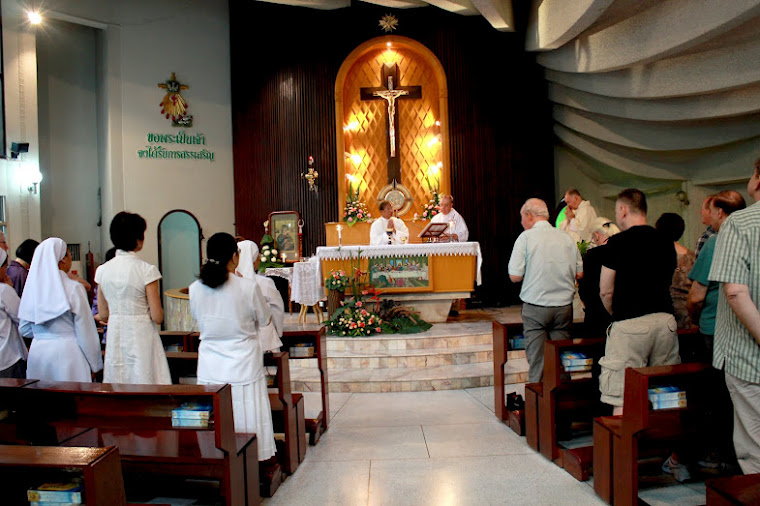
We gather
to give thanks for my 25 years.
Wednesday, October 29, 2014
Wednesday, October 22, 2014
A King Remembered
Otherwise known as King Chulalongkorn, today, Thursday 23rd October, is a holiday in Thailand to remember Rama V who was king of the then Siam from 1868 until 1910. History remembers him as a great king and maybe history is coloured but I tend to agree with history. He was one of the great kings of this country.
He led his people into the 20th century, overseeing reforms and the building up of a new state. He had a vision for his then kingdom. He knew that to stay independent and to be strong, this country needed to modernise and modernise it, he did, and brought it into the 20th century as best he could.
As king, he is remembered as a father to his people and to this day he is remembered with fondness and revered by them. As a Catholic, I now have good Pope Francis to look up to. If I was a Thai and a Buddhist, I would be looking up to a King Chulalongkorn in much the same way.
As I sit in my apartment, I can see my photo of Rama V on my fridge door. He is there standing proudly, dressed in his immaculately tailored military uniform, showing off his decorations of honour. His ceremonial cape looks not just stylish but wealthy. His stance exhibits a certain arrogance. The picture shows him to be a handsome man, a strong man.
Maybe I keep this picture in a prominent place as it is an image that tells me something about the history of where I live. It tells me of the pride it holds and that despite all the difficulties faced here, its people come from somewhere noble, somewhere to be treasured. Is that not the same for all of us? I think this in the very week that Gough Whitlam, ex-PM of Australia, died; in the very week that Paul VI was beatified and Francis so skilfully led us in Synod.
Long live the King! Viva il Papa!
Wednesday, October 15, 2014
The Church on the Move
Monday saw my debut as a movie actor. It will probably be my one and only time to hit the big screen. I starred as a French missionary priest coming to Thailand with the French brothers who began the local and well known Assumption College. The brothers came here over 100 years ago and began their good work.
When I shared my acting news with David, another local ex-pat and friend, he asked the question. Did the brothers start Assumption College as a school for the wealthy?
He asked this because Catholic schools in this country are identified with the wealthy and powerful, being places where wealthy families do send their children. If you just went by the Catholic schools you see in Bangkok, you would judge that the Catholic Church in Thailand is big, powerful and wealthy. The truth is that the Catholic Church here is very small in number. As for wealthy, Bangkok Archdiocese includes Catholic families who have huge wealth. As for powerful, the Church seems to have a standing that goes far beyond its small membership. What I can say is that this Church is about doing business.
My answer to David was that I am sure the brothers came here with a true missionary spirit, being dedicated to spreading the faith and establishing the Church. They would have had poor and humble beginnings, reaching out to the Catholics and the poor people. They established schools to serve a need. The history of Assumption College began in 1885 when Fr Emile Colombet, a French missionary priest, established a schhol to serve Thai children who went without an education. What then happens in time is that their missionary endeavours proved so successful that they attracted the powerful and wealthy, as we see today.
From such humble beginnings we see what we see today. How we can lose touch with our roots!
When I shared my acting news with David, another local ex-pat and friend, he asked the question. Did the brothers start Assumption College as a school for the wealthy?
He asked this because Catholic schools in this country are identified with the wealthy and powerful, being places where wealthy families do send their children. If you just went by the Catholic schools you see in Bangkok, you would judge that the Catholic Church in Thailand is big, powerful and wealthy. The truth is that the Catholic Church here is very small in number. As for wealthy, Bangkok Archdiocese includes Catholic families who have huge wealth. As for powerful, the Church seems to have a standing that goes far beyond its small membership. What I can say is that this Church is about doing business.
My answer to David was that I am sure the brothers came here with a true missionary spirit, being dedicated to spreading the faith and establishing the Church. They would have had poor and humble beginnings, reaching out to the Catholics and the poor people. They established schools to serve a need. The history of Assumption College began in 1885 when Fr Emile Colombet, a French missionary priest, established a schhol to serve Thai children who went without an education. What then happens in time is that their missionary endeavours proved so successful that they attracted the powerful and wealthy, as we see today.
![]() |
| Assumption College today - such grandeur. |
Wednesday, October 8, 2014
It is nine years
![]() |
| Br John Beeching, a Maryknoller in action. |
I arrived on 5th October, 2005. I don't know why I remember the date but I do. This means that last Sunday I have been here nine years. Amazing!
I first came with Maryknoll, the missionary arm of the US Catholic Church, as a volunteer. Br John Beeching was my connection and mentor. I took on teaching English in a Buddhist temple which was seen as an inter-religious project. As well, I ran their volunteer programme for ones coming from the USA. That was how I began.
From the beginning with Maryknoll, I questioned why I was teaching middle-class Thais English for nothing and I asked how I could improve the teaching curriculum. This was all too much for Br John and for the first time in my life I got the sack, with John taking me for coffee to tell me that I would be better placed somewhere else. So Maryknoll Thailand introduced me to the then Fr Pibul in January 2006 and there began my new career with what was to become Caritas Thailand.
And here I am!
I sometimes ask myself why I am still here. The answer is simple. I am where I need to be. I believe this is my place in the world and the Church for now. I say this for a number of reasons.
1) I make a worthwhile contribution through my ministry and work here,
2) I am involved in a life-giving ministry to urban refugees for which I have a passion,
3) I serve a good purpose for my Order, allowing them entry into a cutting edge ministry with migrants and refugees in a part of the world where they want to be more and more present.
Yes, for now, I have found my little corner in world and Church. My Bangkok may be a bit bizarre and intense at times but it is where I belong for now. What more can one ask for in life?
Thursday, October 2, 2014
A frightening insight!
On Sunday, I saw a documentary on the BBC named "My Brother, the Islamist". It was about a young Englishman trying to understand why his brother had become an Islamist. His brother had turned to a form of Islam that allowed a number of such young men to come together and pursue an extreme way of life and philosophy that included belief in using violence to ultimately achieve their religious ideals and pursuits.
The two brothers had grown up together in mainstream Britain. They shared the same family. They enjoyed the same education. So, why such a radical shift by his brother? His brother had chosen a way of life that was so foreign to his family. It was more than just a radical choice with the now violent tendencies held by his brother. They just could not understand what was happening. Why? This was the big question.
As I saw the young Englishman talking with his brother and other young Islamists in Britain, I could see that these men were questioning a godless society and its values and recognizing a need to change. This I can understand. But then they turned to extremism as their only option. This I could not understand.
40 years ago, such people in western society turned to the priesthood or the monastery like me and others who shared the same questioning about a society and world that were so unjust and losing their way. Or else you turned to a worthwhile profession or some sort of service to humanity to make a difference for people and make it a better world. Now I am seeing that our secular societies don't offer this same opportunity and we are paying a terrible price - extremism.
These guys talk of martyrdom. That is a theological theme of religious life. For them, martyrdom is not a theological virtue but a do-it-yourself blow up the world thing.
It then struck me for the first time that this whole Islamist movement is arising in a world where there is a lack of a sense of religiosity, of a sense of the divine in everyday life. These are philosophical terms. It is what everyday talk would refer to as a lack of spirituality. What we are seeing is young men choosing extremism and violence to change the world. This is frightening and it is challenging us to respond not just with force and politics and fear but with a positive religious response.
Christianity is being challenged to put the divine back into our secular societies. This is to be done in good and healthy ways. The aim is to give people life giving options for searching and asking questions in life, for pursuing the human religious quest, for being spiritual people. Society may be secular but the human person remains innately religious and that spirit still needs to be able to find expression. That cannot be taken away by secular society. Here is the responsibility of Church to respond to this human need and not have it ruled or squandered by extremism and violence.
Thursday, September 25, 2014
Where I found Church this past week
Last Friday, I was at farewell drinks for a British couple who had been here in Bangkok for 15 months to work with refugees. They are husband and wife, a great couple. One is a lawyer and the other a social worker. They give their lives to help the desperate populations in our world, choosing not to use their skills just to make big money. Simply, they are two committed citizens who go out to help the little people of our world.
There were some 20 people present enjoying Friday's farewell drinks. They were all individuals like my two friends, young professionals dedicating their lives and skills at least for now to helping humanity. Our friends were now to head off to Cairo to work with refugees there.
One guy at the night heads an international coordinating NGO for NGOs and bodies working for refugees in Asia Pacific. He is totally committed to human rights and works purely to benefit oppressed and low class people. He does great work. He shared that he did not believe in God. I asked him how this fitted in with his commitment and work. He simply replied:
"This is my life. I don't need there to be anything after I die. This is it."
Then I was speaking with a young Australian lawyer who has been here for a time advocating for refugees. She told me that she was now off to Ethiopia to do the same work there. I thought "Wow!"
I could theorize about this experience. Instead I will simply say that in people like this I have the privilege to meet Church today. They are not necessarily Catholics nor do they even believe in God but they are committed to good and to humanity and live out their commitment at great cost. Is that not what Church is about?
Then in this same week, I meet a local bishop, lovley guy. He talks of his diocese. It has a total population of 5.2 million people, of whom 5,500 are Catholics. He has 28 priests and two seminarians. And his big issue? Vocations! How to get more men to be priests?
It strikes me how his reality in Church is so different from the reality of my friends and colleagues at the farewell drinks. While I can understand the bishop's position and lay no judgement on a good man (after all the bishop's agenda is set for him by his role in the Church), his reality and concerns are so narrow. The reality and concerns of my friends and colleagues seem much more real, much more just purely committed to humanity.
Where is Church to be found today?
Wednesday, September 17, 2014
The Catholic church is on track to become a shrinking cult | National Catholic Reporter
This article came to me through my online subscription to NCR. I read it and thought - Wow! I thought this because only last week I got an email from a good friend, a priest in Rome. He was reflecting on the Church in Europe, saying:
"We see the problems of our religious congregations and of the Church. In fact, it is much deeper and is a profound moral morass and if they're not careful they'll be overtaken by more powerful and focused groups. It might be a caliphate. It might be China. But unless they wake up, they'll sink."
I thought my friend a bit dramatic but then his thoughts are reflected in some way by this article which independently came my way at the same time. This is no coincidence.
The Church is losing its way. In the west, I would name it as the Church has lost touch with its own grassroots. Where I live now, the Church has its issues but they appear to be different from ours back home.
I named my growing up in Church as like belonging to a ghetto. Everyone and everything I knew - family, friends, school, the scouts, sporting groups - all were Catholic or else they did not own up to being anything else. The Church was just there, a part of my life as a boy and a teenager. The first time I ever confronted non-Catholics was when I went to work after finishing school and ones there were making fun of me being Catholic. The Church provided me a family and a school, a place to belong and grow. Such a Church no longer exists. You can no longer belong to a ghetto. That is a good thing but for this argument that is by the way, as is the fact that the Church today also has many strengths.
What worries me the most is that the Church of a Cardinal Pell blames us, blames our society and world for what has happened. I would turn it around and ask where has the Church lost the plot and missed opportunities? Where the Church finds herself today has a lot to do with her decisions and actions, or lack of them, and how she presents herself.
Then along comes good Pope Francis and he is calling us to be a Church of the poor, a Church of the people and telling us to get our priorities right, not always just focusing on people's sexual dilemmas or personal proclivities. Pope Francis is calling us to be Church in a fresh and renewed way. A Church caught up in its own life and focusing on select issues; a Church that is hypocritical and unfeeling in the midst of scandal is running the risk of becoming a cult and being overtaken. Francis challenges us to be out there amidst the action and not hide in some cave where we would just become a forgotten or strange cult. He can see this and name it for us.
Good Pope Francis!
Subscribe to:
Posts (Atom)


