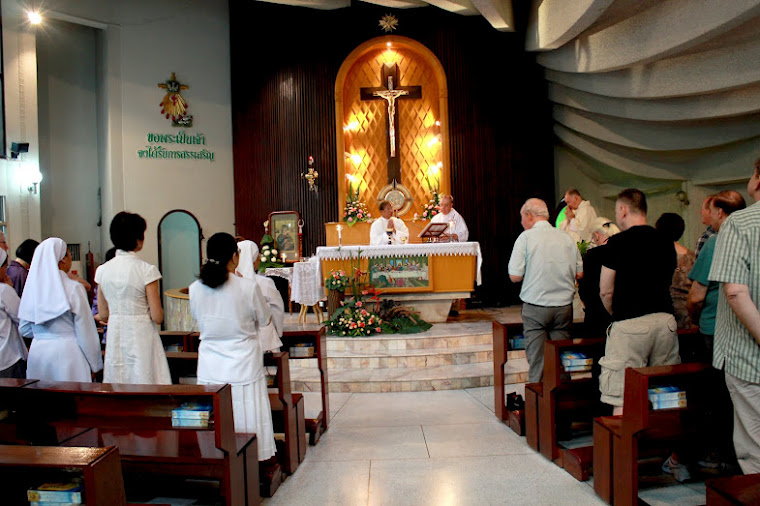
We gather

We gather
to give thanks for my 25 years.

Monday, April 25, 2022

Lest we forget

This week, I am sharing my experience of being at Hellfire Pass in Kanchanaburi for the ANZAC Day Dawn Service.  ANZAC stands for the "Australia and New Zealand Army Corps".  

On 25th April, in 1915, the joint forces of our two nations landed at Gallipoli in Turkey, to embark on what became our first combined campaign in war.  Historically, it turned out to be a disastrous campaign with heavy losses and no chance of winning the battle.  However, defeat was not the end of the story, for courage and camaraderie in the face of great adversity won the day.  This became known as the Spirit of the ANZAC, with Gallipoli becoming the defining moment for the founding narrative of what it means to be an Aussie and a Kiwi. 

So April 25th became the day when we remember our war dead and all those who fought, served and suffered in defence of our peoples and beliefs.  

Hellfire Pass is the ANZAC memorial in Thailand, for here is a particularly harsh section of the railway built by the Japanese during World War II, using Prisoner of War and Asian slave labour, of whom ANZACs were a part.  This place stands as a living memory to how cruel we as humanity can be to our own kind.  But more importantly, it stands as a living memory to the strength and courage of the human spirit in the face of all adversity, ultimately winning the day.   

The experience of the day overcame me emotionally, an experience that made me deeply reflect on what it truly means to be human in the sight of God and our fellow men and women.  Lest we forget!  May peace ever reign for all!  

Hellfire​ Pass​ on​ the​ WWII Thai-Burma Railway -​ ANZAC​ Day 2022

Monday, April 18, 2022

Resurrexit sicut dixit!


This past week has seen the coinciding of Easter with Thai New Year, two central festivals in my present life- one of faith, the other of a nation and its culture.  Both are key to giving meaning in life - one locally, the other universally.  .  

The Latin proclamation, "Resurrexit sicut dixit", was the cry of the early Church.  It proclaimed to the world, "He is risen as he said".  It proclaimed that, through Jesus' resurrection, we know once and for all that life has won over death, light over darkness.  This matters for it proclaims hope ever real and never vanquished to a world that continues to know too much war, too much destruction, too much hunger. too much poverty, too much injustice.  Despite all the suffering our world bears, this central proclamation of the Christian faith rings as true today, as it did 2,000 years ago.  It is needed as much today, as it ever was.  

Two simple gestures of kindness, shown towards me at this time, profoundly touched me.  Chocolate is the gift of Easter back home, a gift that I have not seen in my 16 years here.  Then this Easter, two people gave me chocolates from Australia.  These two, simple gifts provoked good memories in me, showing me the care and goodness ever offered my way by so many.  Life is good.  People are kind.  That is the end of the story.  

Despite all that burdens us, we are here.  So the journey continues.   We are not held back.  We keep getting up and moving on.  This is what matters.  Resurrexit sicut dixit! 

Sunday, April 10, 2022

We become how we live.


At 40, Franz Kafka (1883-1924), who never married and had no children, walked through the park in Berlin when he met a girl who was crying because she had lost her favourite doll. She and Kafka searched for the doll unsuccessfully.
Kafka told her to meet him there the next day and they would come back to look for her.
The next day, when they had not yet found the doll, Kafka gave the girl a letter "written" by the doll saying "please don't cry. I took a trip to see the world. I will write to you about my adventures."
Thus began a story which continued until the end of Kafka's life.
During their meetings, Kafka read the letters of the doll carefully written with adventures and conversations that the girl found adorable.
Finally, Kafka brought back the doll (he bought one) that had returned to Berlin.
"It doesn't look like my doll at all," said the girl.
Kafka handed her another letter in which the doll wrote: "my travels have changed me." the little girl hugged the new doll and brought her happy home.
A year later Kafka died.
Many years later, the now-adult girl found a letter inside the doll. In the tiny letter signed by Kafka it was written:
"Everything you love will probably be lost, but in the end, love will return in another way."
4

"My week ended with my spending time with the two most vulnerable people I presently know in my Bangkok.  You don't need to know who they are.  Just know that they are broken, fragile individuals in need of good and decent care.  On their request, I reached out to them on Saturday.  Their wounds were gaping wide open.  Their journey, seemingly going nowhere, just meanders on.  There I am with them, overcome by own sense of inadequacy, of my going nowhere in helping them.  This is life."      

This was my introduction I had prepared for today's entry.  It was going to lead me along a philosophical path of reflecting on consolation, not comfort, as the way to go in approaching life's woes.  This line comes from a book I have started to read.  The point of the writer was that consolation is about hope - no hope, no life.  So, no matter what, we offer hope.  

Then I read the above post on Facebook shared by a good friend in Dublin.  It immediately pushed all the right buttons for me at this point in time.  I thought, "This is it!"  What more can one say in facing the "slings and arrows of outrageous fortune" in life at the beginning of Holy Week? 

Thank you, Brian.  Thank you, Kafka.  

Sunday, April 3, 2022

I can"t. Really?

I have no wish to get into the fray over the Will Smith slap at the Oscars.  Having said that, I was impressed by a line Smith used in explainig himself.  He said, "I am a work in progress".  Aren't we all a 'work in progress'?    

In this age of a pandemic and wars, the cry of too many around me is defeatist.  There is no 'work in progress' thought alive in their mindset.  Rather I am hearing far too often people seemingly overcome by the 'I cannot' cry, which appears as a cry of this age.  

I appreciate that many are suffering terribly and hurting deep down.  I so feel for them in their plight but we cannot just stay there, as where do we go then?  This cry is the cry of ones seeing no hope, leading nowhere, except to a dead end.  Its path is one of self-destruction.  What purpose does that serve for anyone?  The 'I cannot' cry will ultimately become the 'I will not' cry.  The cry of hopelessness thus becomes the cry of lifelessness. 

Such a cry is the very opposite of the gospel cry, which is a cry for hope, a cry for life for all.  Its cry has a longer title but that is okay, for nothing worthwhile is simple.  It may read as                                        'I can and I will with the help of God and in solidarity with my neighbour'.    

Isaiah 43.
Pope Francis is talking to us of building the culture of social tenderness.  This challenges the world to move from a culture driven by fear, exclusion and domination to a culture driven by trust, fraternity and care for all.  This demands a cultural shift, which is a huge demand, but we can and we will with God's help and in solidarity with each other.  The cry for our new era is not 'I can't', but 'I can'.  


Sunday, March 27, 2022


 ACT OF CONSECRATION TO THE IMMACULATE HEART OF MARY

O Mary, Mother of God and our Mother, in this time of trial we turn to you.  As our Mother, you love us and know us: no concern of our hearts is hidden from you.  Mother of mercy, how often we have experienced your watchful care and your peaceful presence!  You never cease to guide us to Jesus, the Prince of Peace.

Yet we have strayed from that path of peace.  We have forgotten the lesson learned from the tragedies of the last century, the sacrifice of the millions who fell in two world wars.  We have disregarded the commitments we made as a community of nations.  We have betrayed peoples’ dreams of peace and the hopes of the young.  We grew sick with greed, we thought only of our own nations and their interests, we grew indifferent and caught up in our selfish needs and concerns.  We chose to ignore God, to be satisfied with our illusions, to grow arrogant and aggressive, to suppress innocent lives and to stockpile weapons.  We stopped being our neighbour’s keepers and stewards of our common home.  We have ravaged the garden of the earth with war and by our sins we have broken the heart of our heavenly Father, who desires us to be brothers and sisters.  We grew indifferent to everyone and everything except ourselves.  Now with shame we cry out: Forgive us, Lord!

Holy Mother, amid the misery of our sinfulness, amid our struggles and weaknesses, amid the mystery of iniquity that is evil and war, you remind us that God never abandons us, but continues to look upon us with love, ever ready to forgive us and raise us up to new life.  He has given you to us and made your Immaculate Heart a refuge for the Church and for all humanity.  By God’s gracious will, you are ever with us; even in the most troubled moments of our history, you are there to guide us with tender love.

We now turn to you and knock at the door of your heart.  We are your beloved children.  In every age you make yourself known to us, calling us to conversion.  At this dark hour, help us and grant us your comfort.  Say to us once more: “Am I not here, I who am your Mother?”  You are able to untie the knots of our hearts and of our times.  In you we place our trust.  We are confident that, especially in moments of trial, you will not be deaf to our supplication and will come to our aid.

That is what you did at Cana in Galilee, when you interceded with Jesus and he worked the first of his signs.  To preserve the joy of the wedding feast, you said to him: “They have no wine” (Jn 2:3).  Now, O Mother, repeat those words and that prayer, for in our own day we have run out of the wine of hope, joy has fled, fraternity has faded.  We have forgotten our humanity and squandered the gift of peace.  We opened our hearts to violence and destructiveness.  How greatly we need your maternal help!

Therefore, O Mother, hear our prayer.
Star of the Sea, do not let us be shipwrecked in the tempest of war.
Ark of the New Covenant, inspire projects and paths of reconciliation.
Queen of Heaven, restore God’s peace to the world.
Eliminate hatred and the thirst for revenge, and teach us forgiveness.
Free us from war, protect our world from the menace of nuclear weapons.
Queen of the Rosary, make us realize our need to pray and to love.
Queen of the Human Family, show people the path of fraternity.
Queen of Peace, obtain peace for our world.

O Mother, may your sorrowful plea stir our hardened hearts.  May the tears you shed for us make this valley parched by our hatred blossom anew.  Amid the thunder of weapons, may your prayer turn our thoughts to peace.  May your maternal touch soothe those who suffer and flee from the rain of bombs.  May your motherly embrace comfort those forced to leave their homes and their native land.  May your Sorrowful Heart move us to compassion and inspire us to open our doors and to care for our brothers and sisters who are injured and cast aside.

Holy Mother of God, as you stood beneath the cross, Jesus, seeing the disciple at your side, said: “Behold your son” (Jn 19:26).  In this way he entrusted each of us to you.  To the disciple, and to each of us, he said: “Behold, your Mother” (v. 27).  Mother Mary, we now desire to welcome you into our lives and our history.  At this hour, a weary and distraught humanity stands with you beneath the cross, needing to entrust itself to you and, through you, to consecrate itself to Christ.  The people of Ukraine and Russia, who venerate you with great love, now turn to you, even as your heart beats with compassion for them and for all those peoples decimated by war, hunger, injustice and poverty.

Therefore, Mother of God and our Mother, to your Immaculate Heart we solemnly entrust and consecrate ourselves, the Church and all humanity, especially Russia and Ukraine.  Accept this act that we carry out with confidence and love.  Grant that war may end and peace spread throughout the world.  The “Fiat” that arose from your heart opened the doors of history to the Prince of Peace.  We trust that, through your heart, peace will dawn once more.  To you we consecrate the future of the whole human family, the needs and expectations of every people, the anxieties and hopes of the world.

Through your intercession, may God’s mercy be poured out on the earth and the gentle rhythm of peace return to mark our days.  Our Lady of the “Fiat”, on whom the Holy Spirit descended, restore among us the harmony that comes from God.  May you, our “living fountain of hope”, water the dryness of our hearts.  In your womb Jesus took flesh; help us to foster the growth of communion.  You once trod the streets of our world; lead us now on the paths of peace.  Amen.

(Pope Francis asks all Catholics to pray this act of consecration of the world, particularly Russia and Ukraine, to the Immaculate Heart of Mary. He prayed this Marian consecration in St. Peter’s Basilica on the Solemnity of the Annunciation, 25th March, 2022.)


Sunday, March 20, 2022

I am here

Oscar Romero - "Love must win out."

On 24th March, 1980, Archbishop Oscar Romero, of El Salvador, was shot dead while saying mass.  Why would anybody do such a thing?  

Romero was the archbishop of a deeply Catholic country in Central America, at a time when it was divided by a particularly ruthless, civil war.  As a bishop, he was seeing a misguided elite, which wanted full power in order to hold onto wealth, and so murdering innocent citizens, even their priests.  As a bishop, he could not stand idly by and watch.  This motivated him to speak out, to become the voice for a suffering people, earning himself the title of "voice of the voiceless" and the ire of a dangerous elite.  

As the voice for an oppressed and suffering people, he was affirming not simply their right to exist.  Much more, he was affirming their God given right to live life with dignity.  That is frightening for an exclusive class wanting to take full and sole advantage of the world's riches.  However, their way is not the way of a loving and creating God who desires that the fruits of his creation be enjoyed and shared by all, willing that every man and woman be co-creators together.    

When facing such a reality, taking repentance and conversion, two key Lenten themes, seriously has frightening consequences.   Then, we cannot limit these actions' possibilities for renewing and reaffirming each human person and all humanity before God.  We will be called to go beyond the simplistic, even if rightful, approach of focusing on petty, personal sin.  Thus we will assume a wider vision that no longer takes life and humanity for granted.  Thus we will affirm and renew the covenant God has made with all people. Thus we will look at what really matters in life and why truly all of us are here together.  

This will take us to the roots of who we are, to a spirituality common to all humanity, thus moving us beyond ourselves to a revolutionary stance.  Revolutionary, because it necessitates our affirming who we are in radical ways, thus involving us in renewing the human project. 

Here, the great affirmation of Ceilie, the central character in The Color Purple, a novel set in early 20th century, southern USA. rings true.  She proudly proclaimed: "I may be black, I may be a woman, I may be poor, I may be ugly, but I AM HERE."  

We are all here. Amen.